The Pope as Antichrist
[DU ROSIER, Simon.]
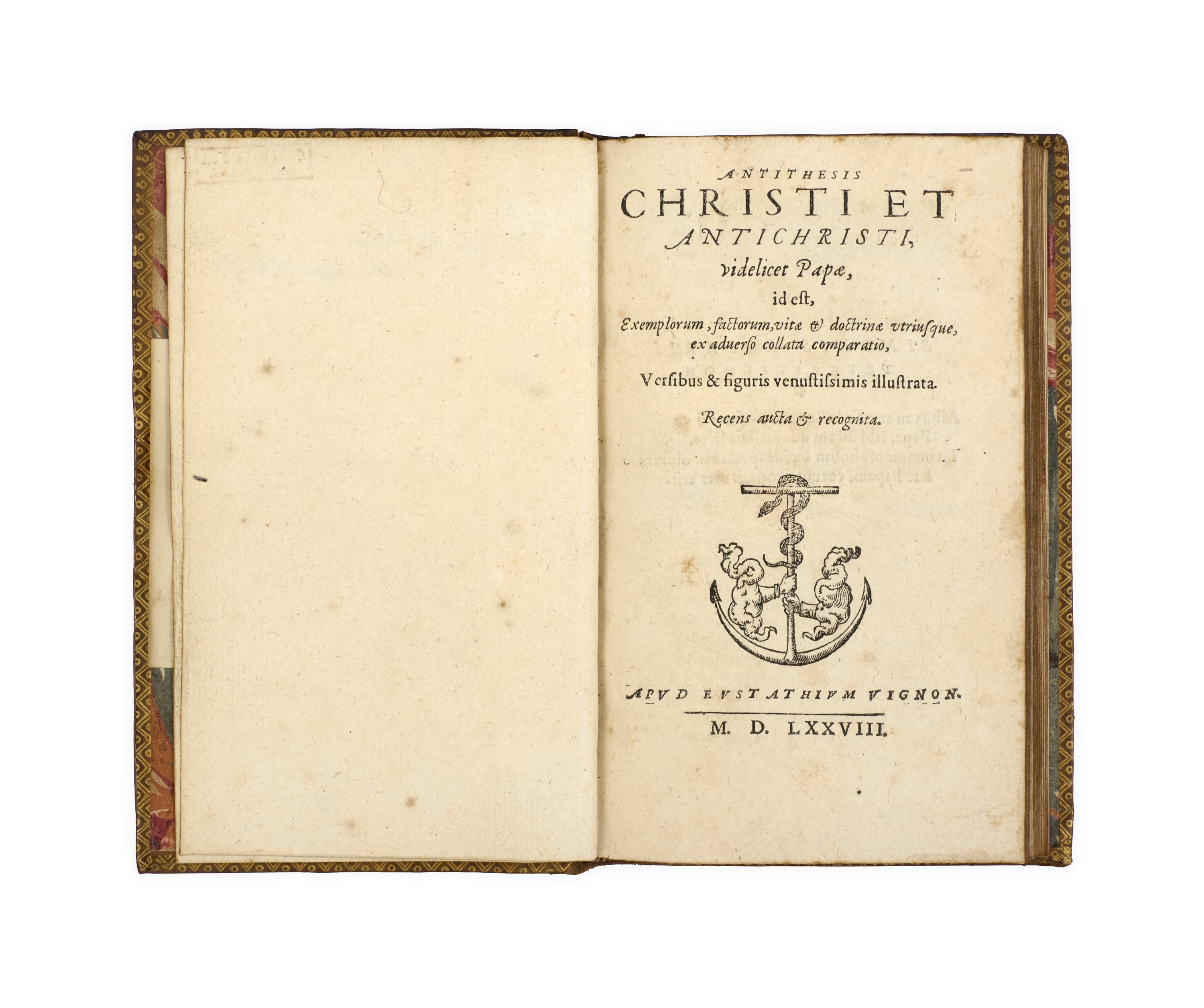
Antithesis Christi et Antichristi, videlicet Papae, id est, exemplorum, factorum, vitae & doctrinae utriusque, ex adverso collata comparatio, versibus & figuris venustissimis illustrata. Recens aucta & recognita. [Geneva], Eustache Vignon, 1578.
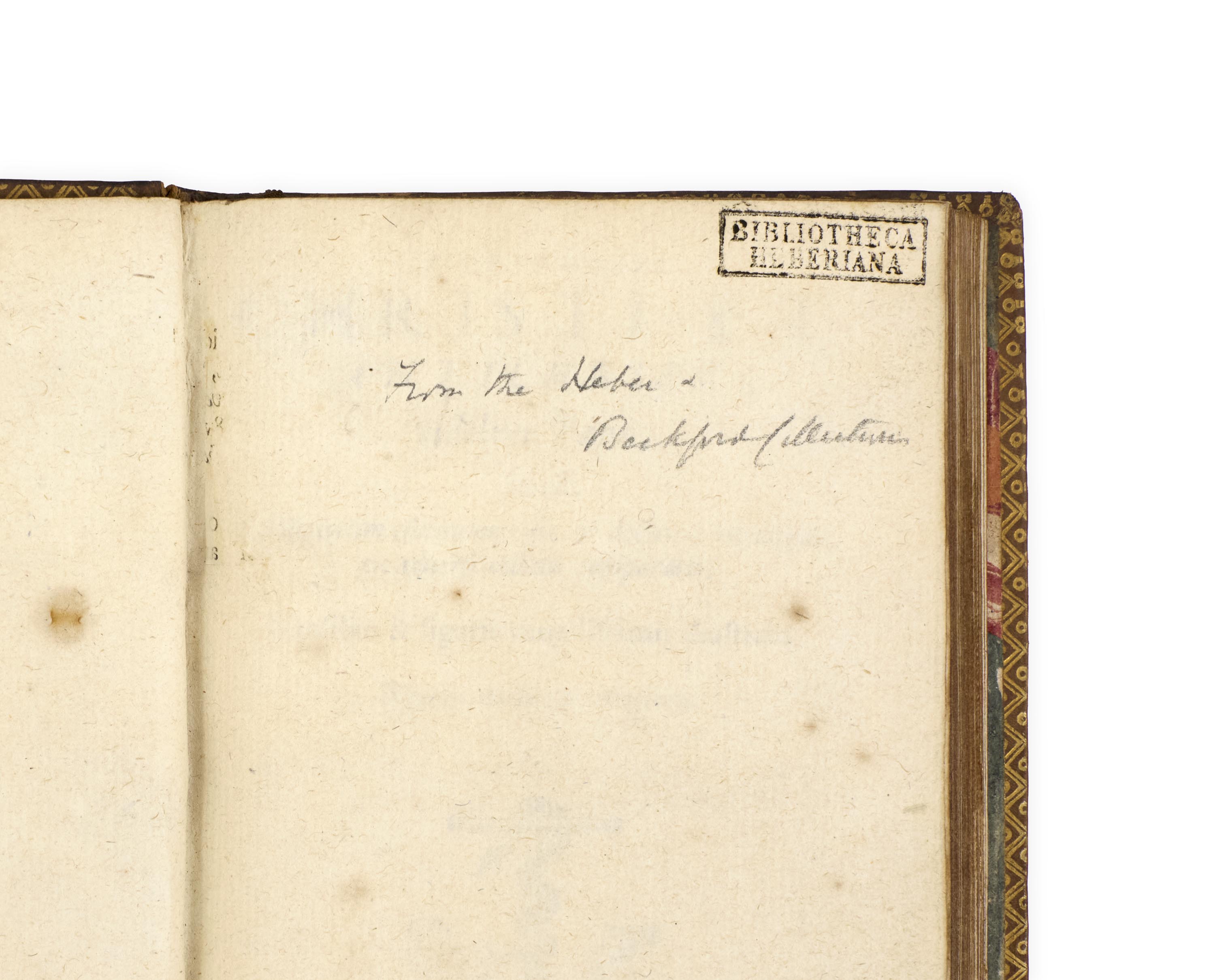
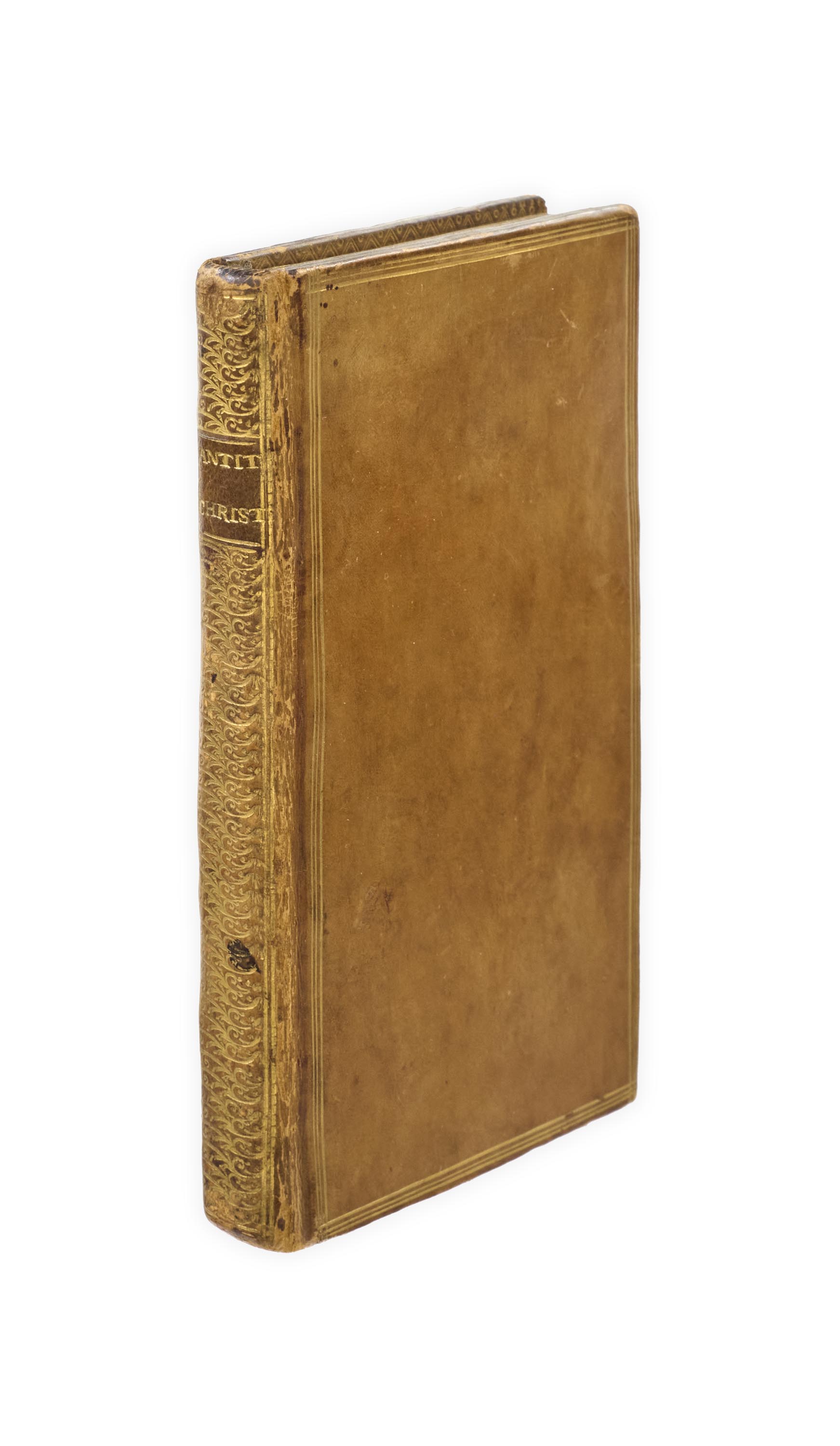
8vo, pp. 147, [1, blank]; with 36 woodcut illustrations, woodcut printer’s device to title, woodcut initials and headpieces; some very faint foxing, nonetheless a very good copy; bound in eighteenth-century polished calf, spine gilt à travers with gilt brown morocco lettering-piece, edges gilt, marbled endpapers, silk place-marker; extremities lightly rubbed; ‘Bibliotheca Heberiana’ ink stamp to front flyleaf, with pencilled note ‘from the Beckford and Heber Collections’ below, bookplate of Samuel Ashton Thompson Yates to front pastedown.
Added to your basket:
Antithesis Christi et Antichristi, videlicet Papae, id est, exemplorum, factorum, vitae & doctrinae utriusque, ex adverso collata comparatio, versibus & figuris venustissimis illustrata. Recens aucta & recognita.
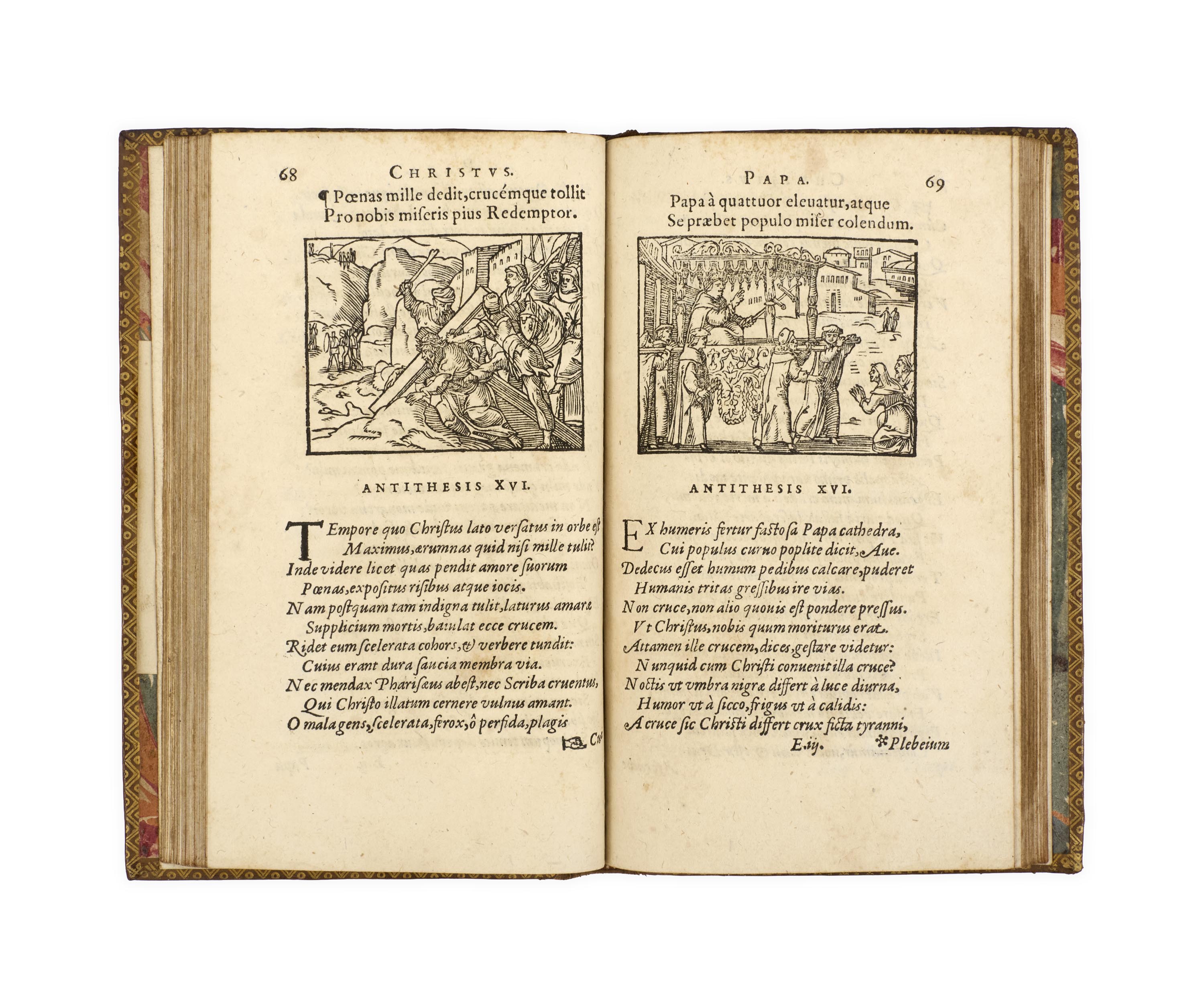
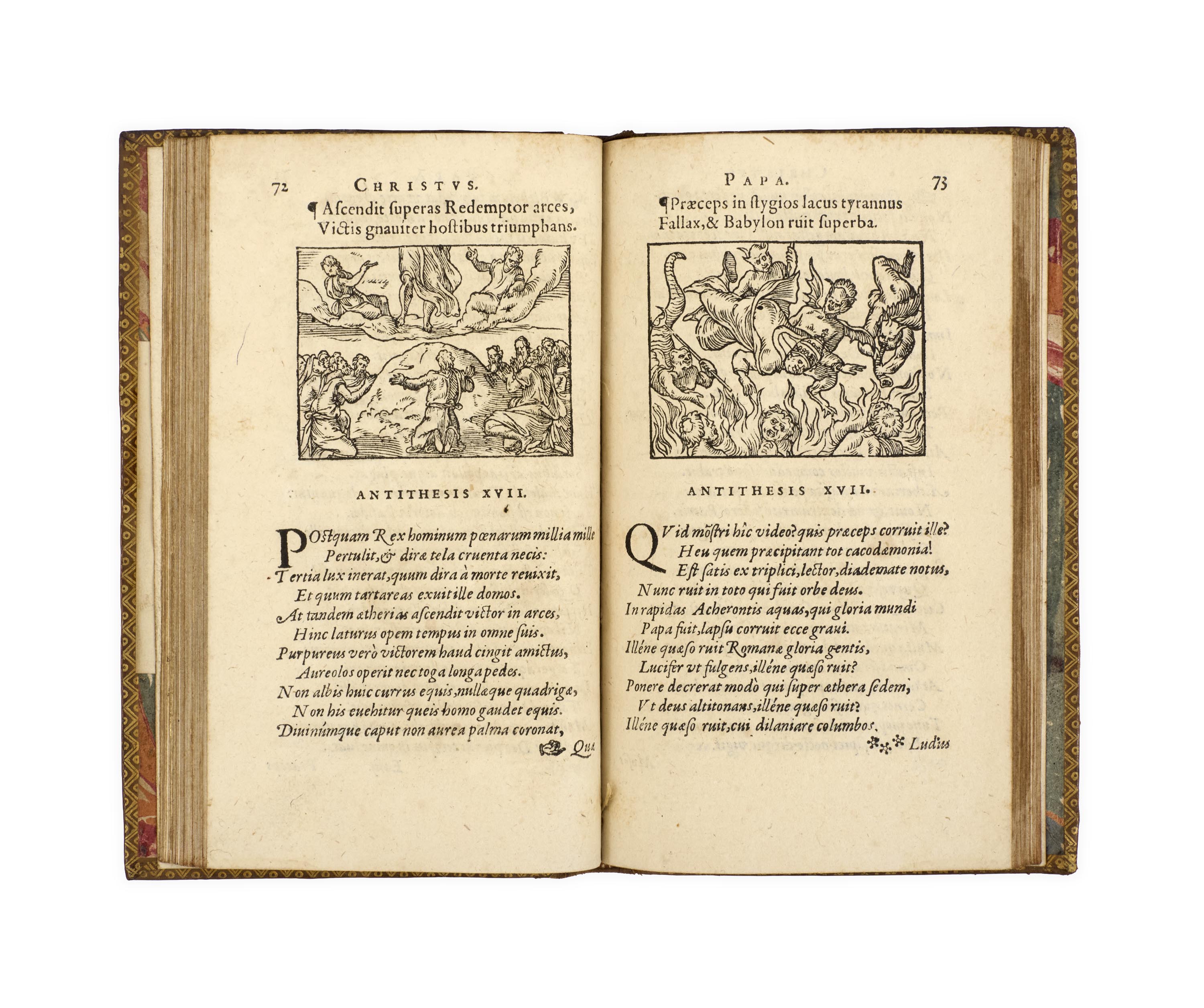
First expanded edition of this satirical attack on the Catholic Church and the Pope by the Protestant minister Simon Du Rosier (or Rosarius), with facing woodcuts juxtaposing images of the Pope’s corruption with scenes from the Life of Christ; the Beckford–Heber–Thompson Yates copy.
First published in Geneva in 1557 as Antithesis de praeclaris Christi et indignis Papae facinoribus, the work is an excellent example of the ‘antithesis genre’, of which the 1521 Passional Christi und Antichristi (attributed to Luther) is the most famous expression. Du Rosier’s work, translated into both French and German, cleverly juxtaposes the humility of Christ with the luxury and avarice of the Pope on facing pages, affirming the Lutheran tenet of the Pope as the Antichrist. This is illustrated by a series of striking woodcuts attributed to Bernard Salomon or Pierre Eskrich after Lucas Cranach the Elder, who had designed the original woodcuts for the Passional.
Among the thirty-six woodcuts are depictions of Christ washing the feet of the disciples, shown opposite the Pope having his feet kissed; Christ crowned with thorns and the Pope with a tiara; Christ bearing the cross while the Pope is carried on an extravagant litter; and the Resurrection opposite the Pope being cast into the flames of Hell; and a final juxtaposition of Moses receiving the Ten Commandments and the Pope collaborating with Satan, a motif not present in the Passional. The present edition is seemingly the first to be expanded with a biography of Gregory VII, a satirical life of Pope Joan, and a letter on the death and apotheosis of Paul III; the last was attributed in the nineteenth century to Matthias Flacius Illyricus. Vignon printed two versions, one with Geneva stated on the title-page (GLN 15–16 2699) and one without, as here.
Provenance:
1. According to the pencilled note, ‘from the Beckford and Heber Collections’, this copy belonged to William Beckford (1760–1844), who ‘spent considerable sums of money on his library at Fonthill in Wiltshire … he sold Fonthill, in 1822, to John Farquhar (who re-sold the contents, including the Library)’ (De Ricci, p. 84). Our copy is most likely the one listed in that sale catalogue, The Valuable Library of Books in Fonthill Abbey, 9 September 1823, lot 3592 (18s). The remainder of Beckford’s collection went to the tenth Duke of Hamilton, his son-in-law, and was later dispersed between 1881 and 1884 (this book was not in those sales).
2. Richard Heber (1773–1833); his sale, Sotheby’s, 10 April–9 May 1834, lot 278.
3. Samuel Ashton Thompson Yates (1843–1903), bibliophile, curate in Lytham and patron of the Thompson-Yates Health Sciences building at the University of Liverpool; this volume is listed in his catalogue Ex Bibliotheca … being a selection from that part of his library under the heads of Books of Emblems and General Literature I (1896), no. 88.
GLN 15–16 2692; USTC 450773; Fairfax Murray, German 371 (calling for thirty-four woodcuts); Graesse I, p. 150 (‘les gravures sont les mêmes, mais le texte est augmenté’). See Manning, The Emblem (2002), pp. 206–207.